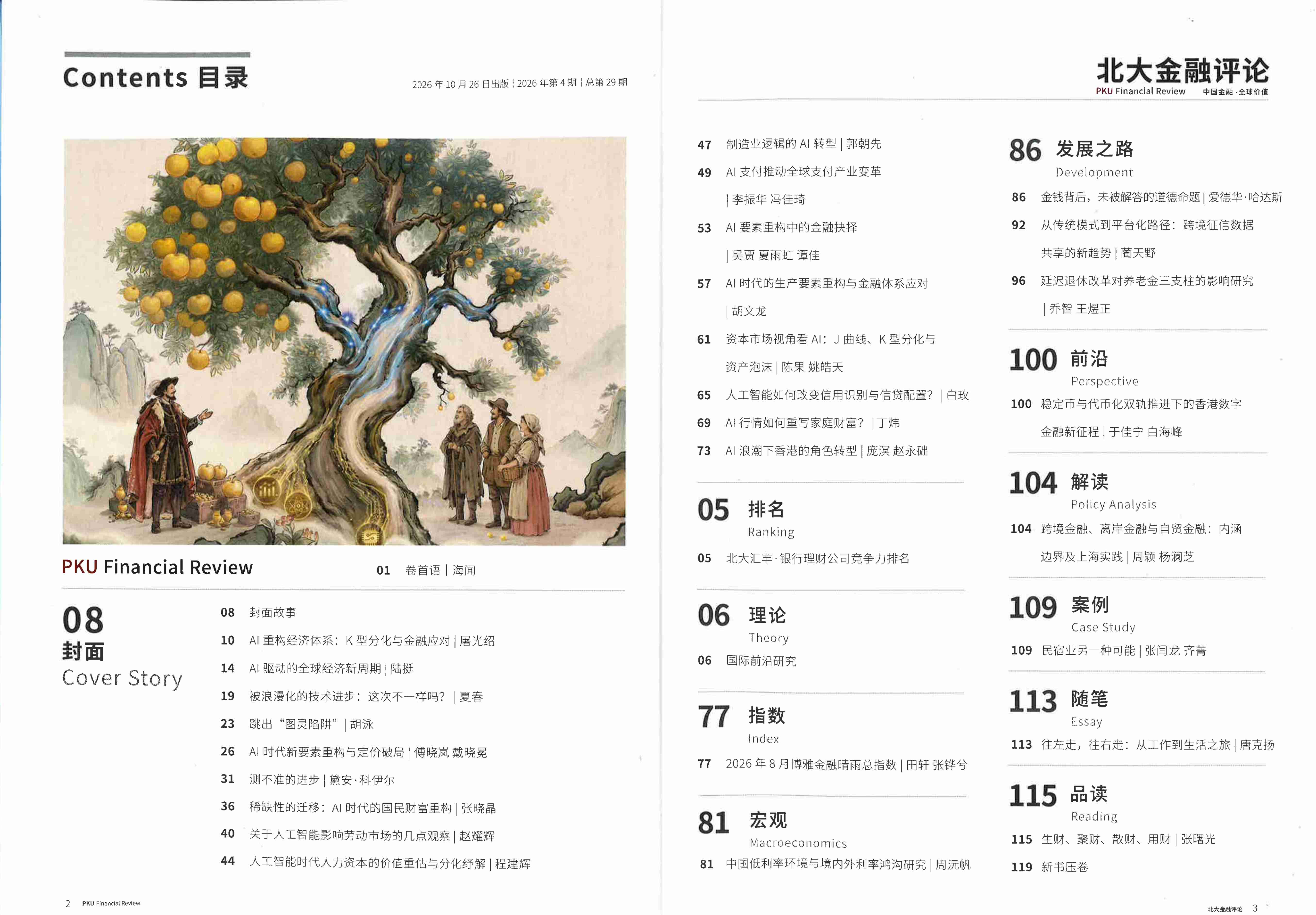
Dr. Zhou Yuanfan, Chairman of the Board of Anrong (Hong Kong) Ratings, Publishes Signed Article in PKU Financial Review
An article by Dr. Zhou Yuanfan, Chairman of the Board of Anrong (Hong Kong) Credit Rating Company Limited, entitled “China’s Low Interest Rate Environment and the Onshore–Offshore Interest Rate Gap,” was published on October 26 in the “Macro” column of PKU Financial Review, Vol. 4, 2026 (Issue No. 29).
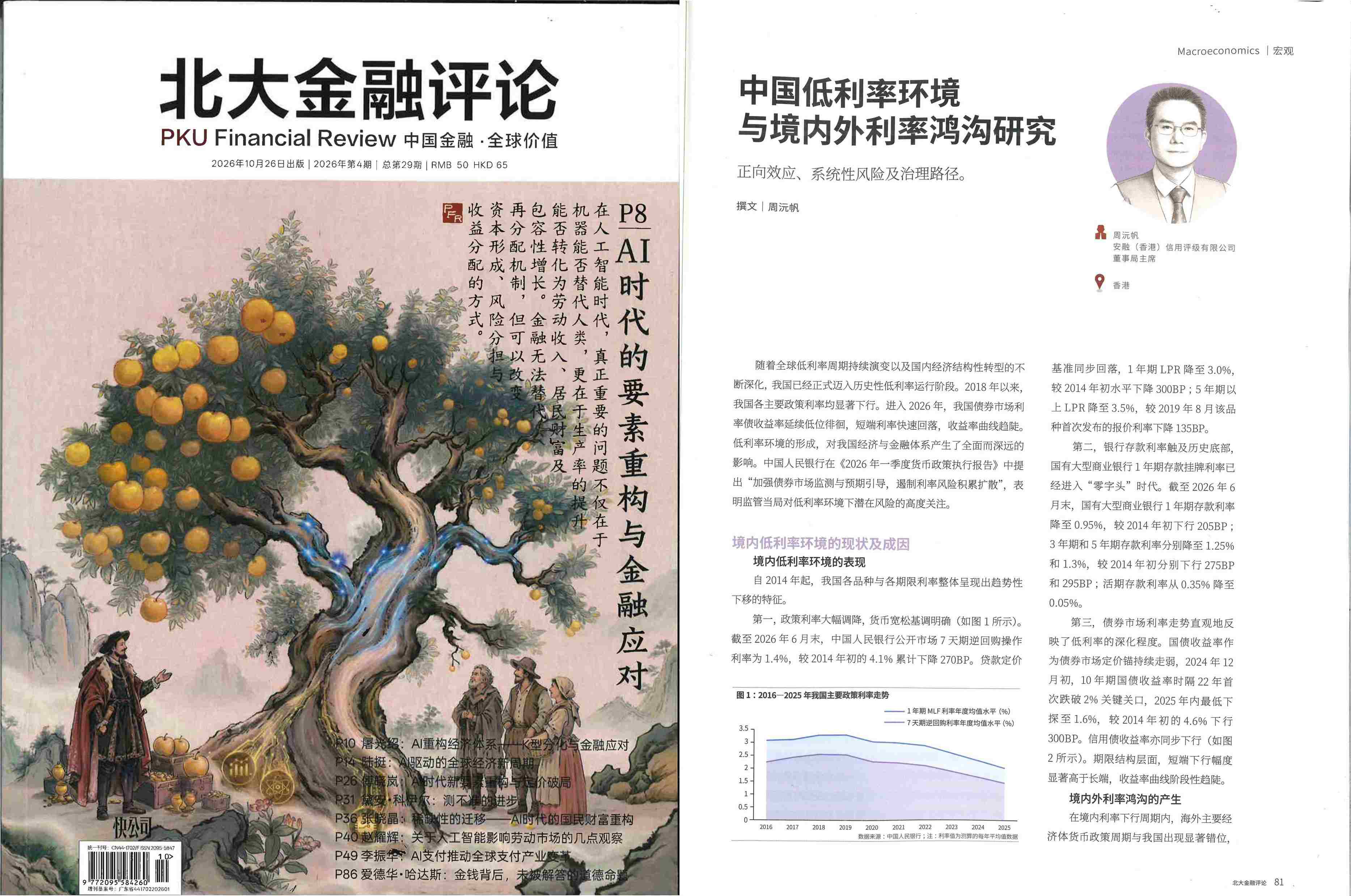
In the article, Dr. Zhou Yuanfan first reviews the multiple dimensions and formation mechanisms of China’s current low interest rate environment. He then shows through his research that a low interest rate environment plays a markedly positive role in stabilizing and reviving the economy, lowering the financing costs of the real economy, and empowering the development of new quality productive forces. Over the long run, however, persistently low interest rates may lead to diminishing marginal effectiveness of monetary policy, heighten volatility in the bond market, and produce complex effects on cross-border capital flows and on the operations of financial institutions. On this basis, Dr. Zhou argues that the low interest rate environment onshore is not sustainable and that the interest rate gap between onshore and offshore markets will gradually narrow. Finally, he sets out policy recommendations covering the coordination of macroeconomic regulation, cross-border capital management, the transformation of financial institutions, and bond market governance.
PKU Financial Review is an academic journal initiated and sponsored by Peking University HSBC Business School and the Peking University HSBC Institute of Finance, both of which also serve as its academic advisers. Hai Wen, Vice Chairman of the Peking University Council and Founding Dean of Peking University HSBC Business School, serves as Chairman of the Academic Committee and Editor-in-Chief; renowned economists such as Li Yining and Justin Yifu Lin sit on the Advisory Committee; and Fan Gang, Wu Zhipan, Liu Wei, Huang Yiping and Jin Li serve on the Academic Committee. Focusing on frontier theoretical and practical research in finance, the journal seeks to foster interaction between academia and industry, to build an open platform for financial research exchange, and to advance academic research as well as industry reform and innovation in China’s financial sector.
Articles carried by PKU Financial Review are closely tied to China’s financial realities and to frontier issues, combining analytical rigor with readability; all are high-quality financial commentaries that have passed rigorous review. Contributors are drawn mainly from scholars at universities and research institutes, senior practitioners at financial institutions, and policy and think-tank researchers. This issue also features signed articles by distinguished Chinese and international scholars, including Tu Guangshao, former Executive Vice Mayor of Shanghai and former Chairman of the Council of the Shanghai Advanced Institute of Finance at Shanghai Jiao Tong University; Lu Ting, Chief China Economist at Nomura; Fu Xiaolan, Fellow of the UK Academy of Social Sciences and Founding Director of the Technology and Management Centre for Development at the University of Oxford; Diane Coyle, Bennett Professor of Public Policy at the University of Cambridge and Fellow of the UK Academy of Social Sciences; Zhang Xiaojing, Director of the National Institution for Finance and Development at the Chinese Academy of Social Sciences; and Edward Hadas, Lecturer in Finance and Research Fellow at the University of Oxford.